Saturday, September 26, 2015

Plate Tectonics - Weekly Blog 09/21 - 09/27

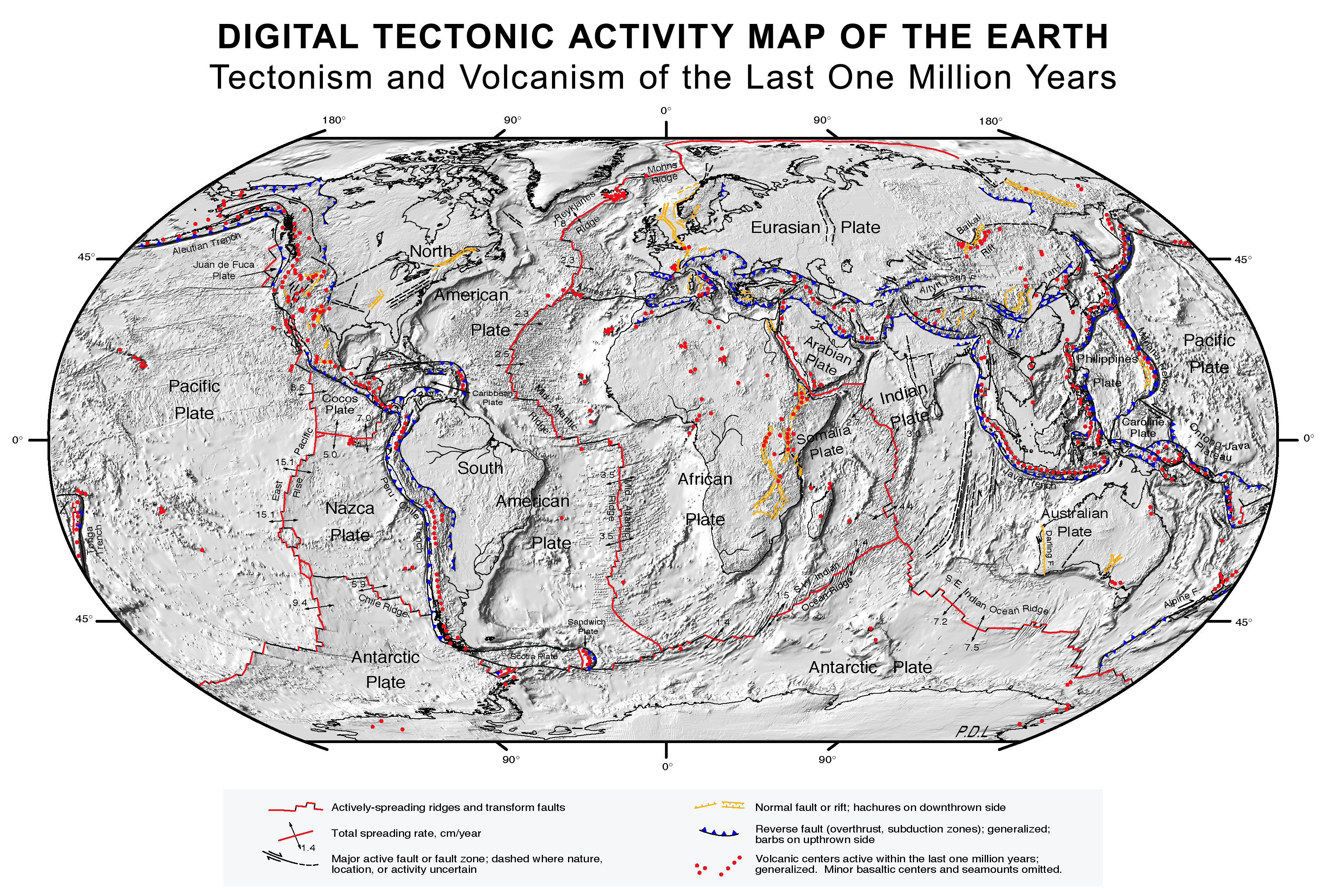
Image: https://upload.wikimedia.org/wikipedia/commons/b/b4/Plate_tectonics_map.gif

Summary:

Alfred Wegener found that Africa and South America have some of the same fossils and plants. He wondered why. When he was making a map, he noticed that South America and Africa kind of fit like a puzzle. This event led him to discover a huge and massive land: Pangea. Pangea meant "all the land". Pangea was the massive land that eventually split up into seven continents. When Wegener shared his work, no one believed him, so his research went to the trash. 20 years after Wegener died, a man named Hesse discovered that the sea floor spreads and the continents move. When he shared this idea, people believed him and found out that Wegener had the same discovery. Hesse had discovered a part of the earth: Plate Tectonics. Plates are different pieces of the crust or lithosphere. It can spread apart, hit each other, and slip past each other. Plates push together, and when they slip, it causes an earthquake. This is called a strike-slip fault.

SP2: Develop and using models

I constructed physical, mental or conceptual models to represent and understand phenomena when I did an activity that showed the earth's layer's development and how long does one thing take to completely develop (actually, parts of the earth are never completely developed). Another activity done this week was how earth quakes work. Me and my table had two wooden bricks with layered clay stacked on top each other on top of the wooden bricks. Below the wooden bricks, there was a magnet so the wooden bricks wouldn't separate far. Then, we placed toothpicks across the clay. The toothpicks resembled a fence. When we moved the two bricks, I saw that the fence kind of moved past each other as if someone had moved them.


Saturday, September 19, 2015

The Rock Cycle - Weekly Blog 9/14 - 9/20


Summary: 

The three types of rock are sedimentary, metamorphic, and igneous. Any of the three rocks can turn into each other. Sedimentary forms when rocks are broken down into sediments and then squeezed together. It takes a long time to get this process done. Metamorphic rocks form when rocks are squeezed by pressure and heat. Igneous rocks form when they are in magma and are cooled. The rocks are usually in volcanoes and when they erupt, the rock is exposed to air, and is cooled, thus turning into an igneous rock. In the rock cycle, heat, pressure, magma, air, wind and erosion help these rocks form into sedimentary, metamorphic, and igneous.

SP8: Obtain, evaluate, and communicate information:

This week, I completed the Rock Cycle Cartoon. I gathered all my data by rolling die and going to the location it tells me to. For example, I started on the soil table, I rolled the die, it told me that pressure occurred and that I had to go to the Earth's interior table. Then, I wrote down each event and where I went to in order. I evaluated my data by reviewing the data I had just obtained. Then, I communicated my information by drawing it on a cartoon, which showed what event happened, and where I went to next. 

Friday, September 11, 2015

Scientific Method Cartoon - Weekly Blog 09/08 - 09/11


Summary: 

This week I made a Scientific Method Cartoon. This followed the new scientific method. I made a draft of my cartoon, and once it got approved, I could move on to my final draft of my cartoon, which is the image above.

Backward Looking:

I have done a similar project like this before last year, in 5th Grade. It was like this one, but it was a cartoon about the water cycle. It had more steps to it and had a different character, which was a rat in drop. That project is similar to the Scientific Method Cartoon and I kind of remember the water cycle cartoon ever since we did this project.

Inward Looking:

If I were to compare this project with something, I would compare it with the Water Cycle Cartoon. I would compare both of them because they are similar. The Scientific Method Cartoon has more slides and has better drawings compared to the Water Cycle Cartoon, which was still good, but was a bit worse in drawings than than the Scientific Method Cartoon, and had less steps which isn't really bad. The only changes I could see are the drawings, since I could see that they have improved.

Outward Looking:

In this project, I would give myself an A. I would give myself an A mainly because I am satisfied about what I made during this project. But also, I think that I did a good job with the drawings and text. Not just those, but also the dialogue. It's not the best drawing, but its good.

Forward Looking:

One thing i'd like to improve upon is my drawing and dialogue. Yes, I know I said they were good to me, but I would just like to improve on it. Also, I would want to make my text more readable because they were not easy to read.

Friday, September 4, 2015

Paper Airplane Experiment - Weekly Blog 08/31-09/06


Summary:

Different kinds of paper made into paper airplanes fly different distances. It depends on their weight, air-resistance, how people throw it, wind, weather, etc. If you don't have a fair test (for example, flying each paper airplane each with a certain force), you won't get accurate results. Once you are done with your experiment, immediately write down your results. After you are done gathering your results, analyze it, see if it matches your hypothesis. If it doesn't, then change your hypothesis and you experiment again. If your results do match your hypothesis share it, or else there is no point in actually making the scientific investigation at all. 

SP8: Obtain, evaluate and communicate information:

My team and I completed a paper airplane experiment which tested which type of paper flew the farthest as a paper airplane. We obtained the information by making experiments and measuring how far the paper airplanes went. We evaluated our data by discussing the results that we got during the experiment. We also Communicated our information by putting our Question, then a Hypothesis, to 
our Results and Conclusion on a poster. When we were putting our data on a poster, we discussed how we should put them in order. 


Friday, August 28, 2015

Scientific Method 08/24 - 08/28

Image source: https://encrypted-tbn3.gstatic.com/images?q=tbn:ANd9GcToR5ENzMjfVnQH7M92dnAuAqRo7Aj-ckTVle-lj3c-7sc0PUJU

Summary: 


The scientific method always starts with a question or problem based on an observation. There are many different orders in which it could be. The summary of the steps are the Observation, Define Question, Research, Experiment, Gather data, make conclusions, and then share your work. There are also a new and old scientific method, but we talked about the new scientific method this week. The NSTA said that "There is no fixed sequence of steps that all scientific investigations should follow". I think this means that there is no real way that you should make a scientific investigation. You make your own, but you can follow other paths.

SP8: Obtain, evaluate and communicate information:

I completed The "NEW" Scientific Method sheet and thought about the order of the steps with my partner that I worked with. We talked about the steps and how they should fit in order. I also completed the Scientific Method Refresher. I obtained information by clicking on provided links and gathering my data there. I evaluated my work by often talking to the person sitting next to me and often talked about some of the questions. I communicated my information by sometimes sharing my ideas with my table mates.


Wednesday, August 19, 2015

Goals for 2015-2016

My goals for 2015-2016:

 -Improve on my Math grades and work (compared to last year).
- Learn how to make better art in art class.
- Learn new cool techniques and facts in all subjects
- Learn a lot more than last year in all subjects
- Type faster than last year
- Improve my grades from last year
- Achieve the highest rank (aka Arch Mage) on science

If all of this happens, I'll celebrate with cake.

Tuesday, May 26, 2015

Weekly Blog 05/29/15

Surprise:
Context: I was surprised when I was reading an article about what killed the dinosaurs.
What: I was surprised when I found out that climate change and cannibalism killed the dinosaurs along with the asteroid.
Why: This is surprising because I only thought that the asteroid killed all the dinosaurs
Tells: This tells me that I should look for more ways on how a certain thing happened before I jump to answers.

Summary:
Cameron Keady in the article, "What Killed The Dinosaurs?"  analyzes the other events that happened that caused the dinosaurs to die out

Citation:
Keady, Cameron. "News." What Killed the Dinosaurs? Cameron Keady, 30 July 2014. Web. 26 May 2015. <http://www.timeforkids.com/news/what-killed-dinosaurs/167841>.

Backward-Looking:
I knew that the dinosaurs died because of an asteroid long time ago. What I know now is that cannibalism and climate change helped make dinosaurs extinct along with the asteroid.

Inward-Looking:
My choice of this article reveals me as someone who is interested in how some certain things happened, like how dinosaurs became extinct.

Outward-Looking:
This article affects the community because it informs them that the asteroid wasn't the only event that happened that caused the dinosaurs to die out.

Forward Looking:
One question I have for the article is if there are more events that caused the dinosaurs to die out. To answer myself, I would say that there are more events, but it hasn't been discovered or mentioned in the article.