Sunday, May 21, 2017

Urban Environmental Accords - (5/15 - 5/19)

Image Source: https://goo.gl/SnUMHb

Summary:

     The urban environmental accords are a set of twenty-one rules that aim to protect the environment, public space, and the health of an urban civilization. The first set of accords lists a set of rules that are intended to reduce energy consumption and introduce renewable energy as an energy source. By reducing the amount of energy being used and having a bit of renewable energy, this reduces air pollution. The next set of rules requires that there must be zero waste in landfills and no harmful substances/products, which reduces the amount of methane going into the atmosphere, decreasing the rate of global warming and making the air quality better. The third, fourth and sixth set of rules ensures that all residents of/and an urban space are healthy. The fifth set reduces the amount of individual vehicles being used, thus reducing the amount of emissions being sent into the air. The final set of rules guarantees accessible water for everyone in the urban space. All these rules ensure that the environment is preserved and the people are healthy and productive.

SP8 - Communicating Information:

     This week I communicated information through the form of a ThingLink, which is an interactive image. The subject that I publicly communicated is how my urban village complies with three environmental accords. I persuasively showed how my urban village complied with the three urban village accords by referencing the furnishings report often and then explaining how the furniture is environmentally friendly (furniture such as solar panels, drinking fountains, etc.). Along with the explanation, I added a brief description of what the accord was, to make sure that people knew what I was talking about. The final thing (unimportant yet relevant) I added was an image to support the rule and my claim.

XCC - Stability and Change:

     The subject that relates to stability and change this week is the environment. The environment has been changing constantly but has changed more frequently since the industrial revolution due to the fact that many sources of energy had emerged and polluted the air and the increase of demand of resources has caused forests to disappear. So the environment is constantly changing due to human activity. It is impossible to make it completely stable, because there will always be a need to resources and buildings to pollute the air. However, it is possible to make the constant changing of the environment close to stable by recycling resources. That would mean that there would be a less demand of resources, which means that sources of resources could remain. Renewable energy is also a way of helping the environment, as it reduces pollution in general.


Sunday, May 14, 2017

The Environment - (5/8 - 5/12)

Image Source: https://goo.gl/05UH5V

Summary:

     The environment is home to billions upon billions of species on earth. There are many parts of the environment. The atmosphere is the layer of gases that protect earth from harmful things such as radiation. The biosphere is the region that is occupied by organisms (land, ocean, sky, etc.). Finally, the hydrosphere are the sources of water on earth. These parts of the environment are rendered useful to us since the hydrosphere is necessary for life, the biosphere provides home for all living organisms, and the atmosphere provides oxygen, protects earth from harmful rays from the sun, and traps heat which makes the earth a good place for life. 

Constructing Explanations: 

    This week, I constructed explanations through the 21 Environmental Accords  sheet. the 21 Environmental Accords is a list of agreements of actions that cities that follow these accords must take in order to maintain a healthy environment. In summary, the 21 accords say, "Reduce the use of energy, reduce waste, ensure cities are safe and environmentally friendly, protect the environment (especially in urban areas), ensure public transportation that is accessible within walking distance in the city that does not affect the environment, and ensure everyone is healthy and has access to safe drinking water. In this sheet, I worked with the person sitting next to me to construct explanations essentially translating the 21 Environmental Accords into our own words. After that, we asked, "what is the purpose of this environmental accord existing?" and wrote down the purpose(s) of why that environmental accord existed and its (positive) impact on the environment.

XCC - Cause and Effect:

     One cause and effect relationship I noticed this week was regarding the environment and the sources of pollution. Since there are more emissions being put into the air and there are more forests being deforested, the global climate is increasing at a rather fast rate. Another effect that comes from pollution is that the biosphere is being affected. Since there is also waste being put out in the ocean, it is harming, if not killing the sea creatures that inhabit the source of water which not only can affect the food chain, but is also harming the hydrosphere which is our only source of water, which can eventually kill us. These are the cause and effect relationships I noticed that come from pollution and effect the environment


Sunday, May 7, 2017

Steady heartbeats may depend on white blood cells (5/1 - 5/5) Article Blog

Article Source: Eaton, Elizabeth. "Steady Heartbeats May Depend on White Blood Cells." Science News for Students. ScienceNewsforStudents, 05 May 2017. Web. 07 May 2017. <https://www.sciencenewsforstudents.org/article/steady-heartbeats-may-depend-white-blood-cells>.

Summary: 

     According to a recent study made by Matthias Nahrendorf and his cell biologist team in Harvard Medical School, macrophages (immune cells) may most likely be linked to the constant beat of the heart. The macrophages lie between heart muscle cells and helps the heart muscle cells receive electrical signals in order to pump the heart in a consistent pattern. Researchers have known about macrophages in the heart but didn't really know much else. Nahrendorf found that a mouse that had very little macrophages in its heart didn't have a consistent beat through the MRI scan, which lead him to discover macrophages are linked to the heart.

SP8 - Communicating Information:

     In the article, the author communicated information by sharing the study made by Nahrendorf. What the author did was include what the discovery was, who did it, and how the study was made. By making this article, the author has shared new information that no one has known before. This is taking a step forward in the understandings of nature since it gives us more information about how the heart works. Researchers/Scientists can use this information to their advantage and perhaps treat heart diseases related to the rhythm of the beat of the heart. 

Sunday, April 30, 2017

A Slice of Pi | TIME for Kids (4/24 - 4/28) Article Blog

Article Source: Katzman, Rebecca. "News." A Slice of Pi | TIME For Kids. Time Inc., 14 Mar. 2017. Web. 30 Apr. 2017.


Summary: 

     Circles are an important part of life, and are pretty much everywhere you go. From earth being a 3D circle, to tunnels and pipes and from the shape of clocks.. Circles are an important part of life. To measure a circle, you must divide the circumference (perimeter of a circle) by the diameter of a circle. What you get as the product is pi. Or an infinite irrational number (a number that cannot be written as a fraction) that when rounded, is 3.14. Since circles and Pi are a significant part of our everyday lives in (measuring) circles, Pi Day is a day to recognize the shape and the irrational number. it is celebrated on March 14th in the U.S since they follow the mm/dd/yy format and when March 14th is plugged into that format, it makes the date 3/14 which are the rounded numbers of Pi. Countries that follow the dd/yy format celebrate Pi Day on July 22nd since it dates 22/7 which is very close to the number Pi.

[Author's] SP8 - Communicating Information: 

     In the article, the author uses communication to take a step forward in our understandings of the natural world. The author uses many examples of how circles are used in the natural world through communication in the article. These examples include the earth, which is essentially a 3D version of a circle, a tree which when cut, shows many rings, or circles on it, and shows that the eye's pupil is also a circle. These examples show the significance of circles. The author also shows that circles can be measured through the number Pi which is circumference/diameter. With this, the author also mentions that due to the importance of circles, Pi Day exists as a recognition to the shapes. The author basically communicates the importance of circles through the article. 

Friday, April 7, 2017

Laws and Bonds of Chemical Reactions - (4/3 - 4/7)

Source: https://goo.gl/vQx81a

Summary: 

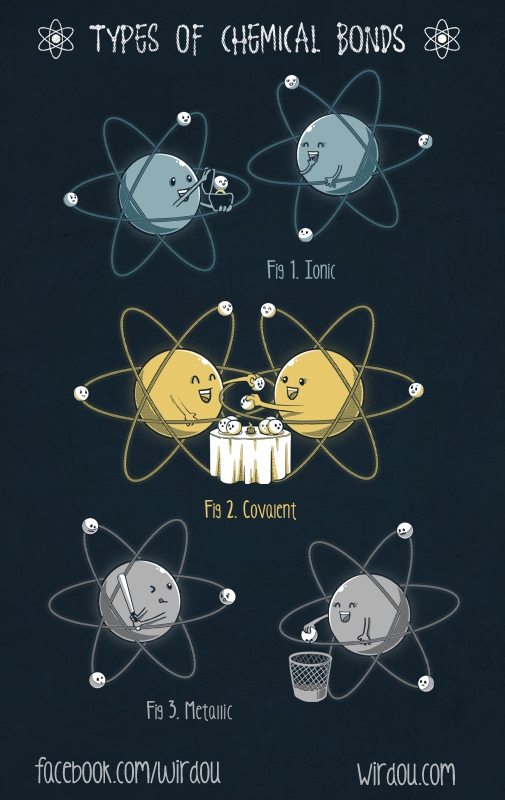
      When one or molecules mix together as reactants, a chemical reaction sometimes occurs, making a product. There are some rules that happen in every chemical reaction. The Octet Rule states that atoms will gain or lose electrons in order to obtain 8 electrons in its outer shell so it. This is so it can act similar to a noble gas. The Law of Conservation of Mass states that atoms cannot be destroyed nor created during a chemical reaction.  The product is simply a rearrangement of the reactants and the chemical equations are balanced. When a chemical reaction occurs, there are bonds that happen. A covalent bond is when atoms share electrons in order to gain 8 electrons in its outer shell. An ionic bond occurs when one atom takes an electron from another atom, making one atom a positive ion and another a negative ion, which means that they attract each other. Ionic bonds can create ionic crystals which means that an ionic bond attracts similar ionic bond pairs until there are no more nearby. 

SP5 - Using Mathematics:

     This week I used mathematics to count how many atoms were in a formula. I used the subscript next to an element to find how many of that element was in the formula. If the subscript was to the right of elements enclosed in parenthesis, that meant that you had to multiply the subscript by how many of each element you had in the parenthesis. For example, if I had (H2 + O)2, there would be 4 hydrogen atoms and 2 oxygen atoms since you distribute the 2 among both elements in the parenthesis. In addition to having a subscript, there was a co-efficient which showed how much of each element there was to the right of that subscript. The equation 2H + Cl meant that there were 2 hydrogen atoms and 2 Chlorine atoms since you are supposed to multiply 2 by anything to the right of it. If there was a parenthesis with a subscript and a co-efficient, you would first remove the parenthesis is then remove the co-efficient

XCC - Scale, Proportion and Quantity:

     Something that is affected by scale is ionic bonds and chemical reactions. When an ionic bond forms, it can attract other similar pairs of ionic bonds in order to create ionic crystals, such as salt. It is affected by scale due to the fact that when the bond is created, it can attract other bonds to become bigger. Chemical reactions are also something that are affected by scale. Take the reaction of vinegar and baking soda. When you mix vinegar and baking soda together, it foams and expands, also creating carbon dioxide. If you add more vinegar and/or baking soda,  it can create more carbon dioxide and expand more and is thus affected by scale.

Sunday, April 2, 2017

The Many Different Arrangements of Elements (feat. Chemistry) - (3/27 - 3/30)

Image Source: https://goo.gl/4cOvnG

Summary:

     Atoms can be arranged in different ways which change how they act with other arrangements of atoms. An element is a type of atom. A pure substance has a definite (all the same) physical and chemical properties. A compound is a pure substance- it has a definite composition of atoms, but in addition to that, it can also not be separable and must be chemically bonded. However, a mixture is the opposite of a compound; it has various compositions, is easily separable, and is not chemically bonded. There are two types of mixtures: homogeneous mixtures and heterogeneous mixtures. A heterogeneous mixture is a mixture that is not the same throughout and is considered the least mixed. If it is uniform throughout, it is a homogeneous mixture, as long as it can still be separated by physical means. Two other different types of arrangements of atoms are colloids and solutions. Solutions are a homogeneous mixture that is created when a substance dissolves in another. A colloid has particles that are mixed together, but are not dissolved and has its particles permanently suspended.

SP3 - Conducting Investigations: 

     This week I conducted investigations on which compounds and elements to mix as reactants in order to create a product which was usually salt, heat, fire or a different element. I identified my variables and controls. My variables were the three or less reactants that had to be in the mixing chamber and my controls were only to add/remove heat. I designed and performed experiments to test my hypotheses. I usually thought that to make the product, you would need elements and compounds as reactants that had the components of the product and this usually the case. If my hypotheses did not work, I used other elements as reactants that had the same components as the required product or tried mixing elements to yield new products that could be used as reactants. I decided to collect data. The data contained what product I needed to create, the reactants that I had, and the formula needed to create the product. 

XCC - Cause and Effect:

     One cause and effect relationship that I have identified in the past is about chemical reactions. Many everyday events happen due to chemical reactions. Due to chemical reactions simultaneously happening in the body, digestion can happen which is necessary for energy. Chemical reactions also cause the result of medicines and vaccines being made  which have increased humanity's lifespan. On the flip-side, chemical reactions also cause fires which produce harmful gases. These are a few examples of how chemical reactions cause everyday occurrences.