Sunday, April 16, 2017

Friday, April 7, 2017
Laws and Bonds of Chemical Reactions - (4/3 - 4/7)
 |
| Source: https://goo.gl/vQx81a |
Summary:
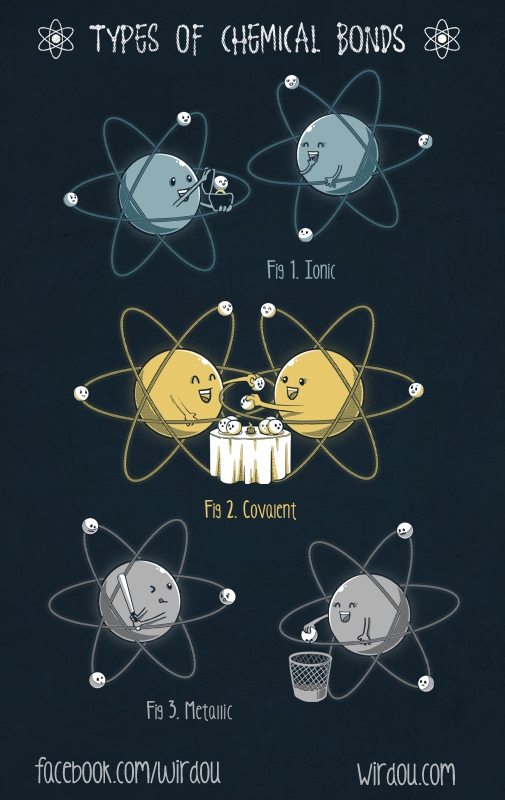
When one or molecules mix together as reactants, a chemical reaction sometimes occurs, making a product. There are some rules that happen in every chemical reaction. The Octet Rule states that atoms will gain or lose electrons in order to obtain 8 electrons in its outer shell so it. This is so it can act similar to a noble gas. The Law of Conservation of Mass states that atoms cannot be destroyed nor created during a chemical reaction. The product is simply a rearrangement of the reactants and the chemical equations are balanced. When a chemical reaction occurs, there are bonds that happen. A covalent bond is when atoms share electrons in order to gain 8 electrons in its outer shell. An ionic bond occurs when one atom takes an electron from another atom, making one atom a positive ion and another a negative ion, which means that they attract each other. Ionic bonds can create ionic crystals which means that an ionic bond attracts similar ionic bond pairs until there are no more nearby.
SP5 - Using Mathematics:
This week I used mathematics to count how many atoms were in a formula. I used the subscript next to an element to find how many of that element was in the formula. If the subscript was to the right of elements enclosed in parenthesis, that meant that you had to multiply the subscript by how many of each element you had in the parenthesis. For example, if I had (H2 + O)2, there would be 4 hydrogen atoms and 2 oxygen atoms since you distribute the 2 among both elements in the parenthesis. In addition to having a subscript, there was a co-efficient which showed how much of each element there was to the right of that subscript. The equation 2H + Cl meant that there were 2 hydrogen atoms and 2 Chlorine atoms since you are supposed to multiply 2 by anything to the right of it. If there was a parenthesis with a subscript and a co-efficient, you would first remove the parenthesis is then remove the co-efficient
XCC - Scale, Proportion and Quantity:
Something that is affected by scale is ionic bonds and chemical reactions. When an ionic bond forms, it can attract other similar pairs of ionic bonds in order to create ionic crystals, such as salt. It is affected by scale due to the fact that when the bond is created, it can attract other bonds to become bigger. Chemical reactions are also something that are affected by scale. Take the reaction of vinegar and baking soda. When you mix vinegar and baking soda together, it foams and expands, also creating carbon dioxide. If you add more vinegar and/or baking soda, it can create more carbon dioxide and expand more and is thus affected by scale.
Sunday, April 2, 2017
The Many Different Arrangements of Elements (feat. Chemistry) - (3/27 - 3/30)
 |
| Image Source: https://goo.gl/4cOvnG |
Summary:
Atoms can be arranged in different ways which change how they act with other arrangements of atoms. An element is a type of atom. A pure substance has a definite (all the same) physical and chemical properties. A compound is a pure substance- it has a definite composition of atoms, but in addition to that, it can also not be separable and must be chemically bonded. However, a mixture is the opposite of a compound; it has various compositions, is easily separable, and is not chemically bonded. There are two types of mixtures: homogeneous mixtures and heterogeneous mixtures. A heterogeneous mixture is a mixture that is not the same throughout and is considered the least mixed. If it is uniform throughout, it is a homogeneous mixture, as long as it can still be separated by physical means. Two other different types of arrangements of atoms are colloids and solutions. Solutions are a homogeneous mixture that is created when a substance dissolves in another. A colloid has particles that are mixed together, but are not dissolved and has its particles permanently suspended.
SP3 - Conducting Investigations:
This week I conducted investigations on which compounds and elements to mix as reactants in order to create a product which was usually salt, heat, fire or a different element. I identified my variables and controls. My variables were the three or less reactants that had to be in the mixing chamber and my controls were only to add/remove heat. I designed and performed experiments to test my hypotheses. I usually thought that to make the product, you would need elements and compounds as reactants that had the components of the product and this usually the case. If my hypotheses did not work, I used other elements as reactants that had the same components as the required product or tried mixing elements to yield new products that could be used as reactants. I decided to collect data. The data contained what product I needed to create, the reactants that I had, and the formula needed to create the product.
XCC - Cause and Effect:
One cause and effect relationship that I have identified in the past is about chemical reactions. Many everyday events happen due to chemical reactions. Due to chemical reactions simultaneously happening in the body, digestion can happen which is necessary for energy. Chemical reactions also cause the result of medicines and vaccines being made which have increased humanity's lifespan. On the flip-side, chemical reactions also cause fires which produce harmful gases. These are a few examples of how chemical reactions cause everyday occurrences.
Sunday, March 26, 2017
The Periodic Table - (3/20 - 3/24)
 |
| Image Source: https://goo.gl/r2miTF |
Summary:
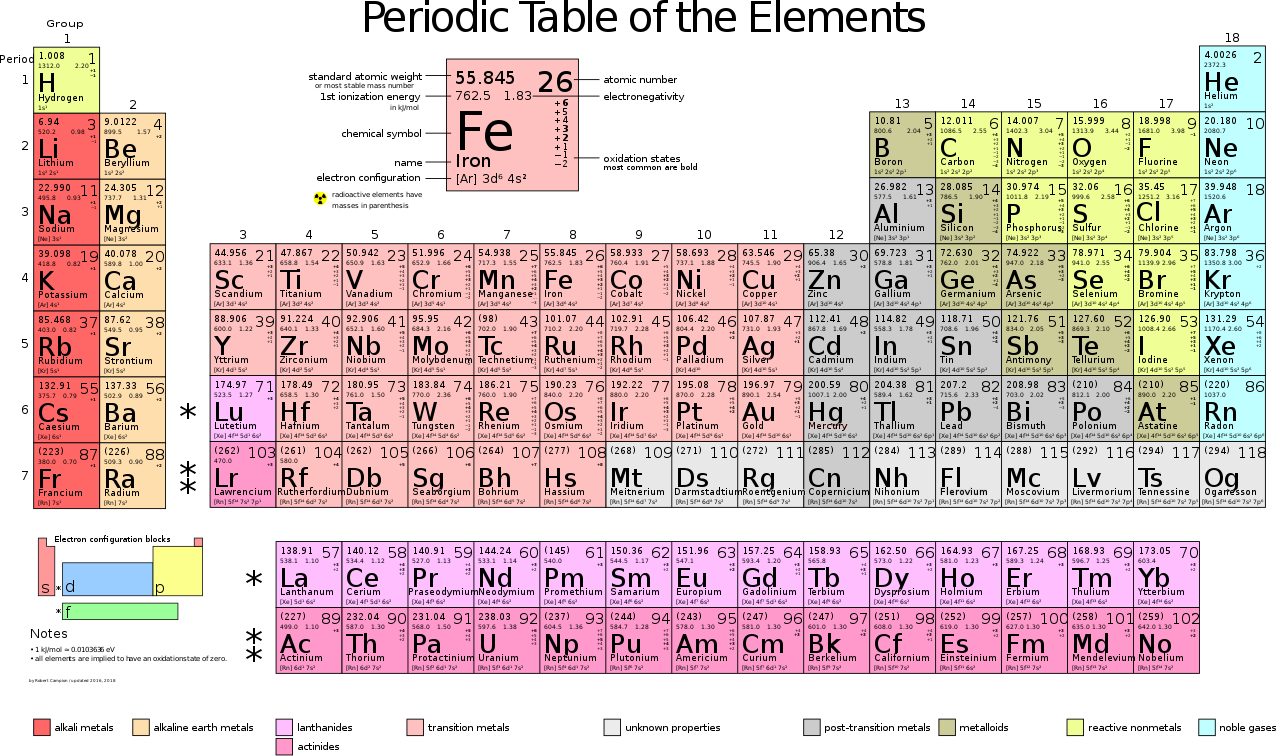
The periodic table is a table that organizes all 118 elements on earth from left to right. based on their atomic number. Each column is called a family and each row is called a period. Each element in a period has the same energy levels, and as you go down, there is an extra energy level added. An energy level is an imaginary circle around the nucleus of an atom. The first energy level contains a maximum of two atoms and the second energy level contains a maximum of 8 atoms. The further the energy level, the higher the electron capacity in that energy level. In the periodic table, there are five families: The alkaline metals, the Alkaline Earth Metals, the Transition Metals, the Boron Family, Carbon Family, Nitrogen Family, Oxygen Family, Halogens, and Noble Gases. Noble Gases don't react at all while Halogens and Alkaline Metals are very reactive. Transition Metals and Alkaline Earth Metals mold and bond with another atom.
SP5 - Using Mathematics:
This week, I performed mathematics to find how many protons, electrons, and neutrons were in the first 20 elements of the periodic table. The only thing provided was the element name, number and mass. To find the amount of protons and electrons, I simply looked at the atomic number since the the atomic number shows the amount of protons and a balanced atom would have the same number of atoms and electrons. To find the amount of neutrons, I subtracted the atomic mass by the amount of protons, since the atomic mass is the sum of protons and neutrons. Then I rounded to make the amount of neutrons a whole number, since you cannot have a part of a neutron.
XCC - System and System Models:
One system (not necessarily a system) was the atom. The atom is the most basic building block of matter. There are three parts that make up an atom- the electron (negative charge), the proton (positive charge) and the neutron (neutral charge). The electrons and the protons determine the charge of the atom. If there as an unstable charge (an uneven amount of protons and electrons), the atom won't be able to function. The neutron determines the stability of the atom. There can be an extra amount of protons and these are called isotopes. However, if there are too many protons, the atom may become unstable and not work. This system of atoms can be connected to another system of atoms to create bigger things such as cells which can create organisms.
Sunday, March 19, 2017
Matter - (3/13 - 3/17)
 |
| Image Source: https://goo.gl/SbNMUt |
Summary:
Matter is anything that has mass and takes up space. Matter is made up of atoms, which are made up of three particles. These particles are known as protons, electrons and neutrons. Protons and neutrons make up the nucleus (center) of the atom while the electron orbits it. The amount of protons in an atom decides what type or element the atom is. for example, if there is only one proton in an atom, it is a hydrogen atom. The atomic number of an element is how many protons are in the atom and the atomic mass is the sum of protons and neutrons. The amount of neutrons and electrons are usually the same as the protons. If there are electrons taken away, it is called a Cation, which makes the atom charge positive, and if there are electrons added, it is called an Anion which makes the atom charge negative since electrons have a negative charge. A combination of more than one atom is called a molecule, and a compound is made up of two or more different elements.
SP5 - Using Mathematics:
I used mathematics to calculate out of the 5 identical crowns, the one that was made of pure gold. I was given a situations where King Arthur's crown was missing. His knights gave him 5 identical crowns and I had to find the one that was his. Each crown provided the information of its mass and who retrieved it. All crowns had a volume of 180cm^3. Below crowns provided the densities for common minerals such as gold, which had a density of 18.3. To calculate which crown had that density, I divided the volume by mass and found out which crown had that density. I also used math when calculating the volume of a stack of pennies by using the formula pi x r^2 x h. I also used the water displacement method. I placed the pennies in a 50 millimeter test tube and observed how far the water rose. I subtracted the new level of water by the original level of water to see how much mm the stack of pennies took.
XCC - Cause and Effect:
One cause and effect relationship I identified that relates to matter is rain. Rain occurs because the atoms that make liquid separate due to heat and rise into the air. When there is too much of the evaporated liquid in the air, it starts to rain as the liquid it once was. You can test out this relationship by having a pot of water, a boiler or something to heat it up at the bottom, and a plate hovering over the pot. When boiling the pot of water, the water turns into steam and sticks to the plate. After a while/when the water is cooled, the steam turns into water and falls from the plate. This is a good model to test and represent rain in real life.
Wednesday, March 8, 2017
Ecosystems Closure: Project Blog - (3/6 - 3/9)

Summary:
An Ecosystem is the interaction of living and non-living organisms, known as biotic and abiotic things. Normally, an ecosystem can stay stable since there is an equal amount of everything. However, it can go unstable (sometimes permanently) for several reasons. One can be that there is a lack of one or more organisms. For example, if the fox population in a fox-rabbit-grass ecosystem disappeared decreased significantly, the rabbit population would increase since there is no fox eating the rabbits, making the grass population decrease since all the rabbits are eating it. Another way that an ecosystem can go unstable is if an invasive species (a non-native species) is introduced into the ecosystems. It can eat the prey faster making the predator population decrease, or can make the producer population go extinct, killing the energy pyramid.
Backwards Looking - How much did you know about the subject before we started?:
I knew most of the things learned in this unit. I knew that an ecosystem had an energy pyramid with the apex predators at the top, the primary, secondary and tertiary consumers in the middle, and the producers (plants) at the bottom of the pyramid. At the very bottom of the pyramid had decomposers which turned the dead organisms into nutrients which went into the soil for the plants to use. I also knew the effects of an unbalanced ecosystem if a certain population increased or decreased. For example, I knew that if the primary consumer population increased, then the producer population would decrease. Before I started on the ecosystems unit, I also knew a little bit about invasive species and how they would affect the non-native ecosystem it entered.
Inward Looking - How do you feel about this piece of work? What parts of it do you particularly like? Dislike? Why? What did/do you enjoy about this piece or work?:
I thought that this project could have been a lot better than it was. The main thing that I thought could have been better was the execution of the information I had gathered. The part of this project I personally liked was the brainstorming and research since I could explore which invasive species I could present. The part that I dislike the most was making the actual poster, since although the information I gathered sufficed, I thought that I could have added more graphics and made the poster much more neater. I also thought that the presentation could have been better since I was unprepared for it and had no script.
Outward Looking - Did you do your work the way other people did theirs? In what ways did you do it differently? In what ways was your work or process similar?
Many of the presentations I saw had work that was online/on a device. However, the work that I presented was a physical poster talking about my invasive species. Also, some groups didn't do the invasive species project. Some groups talked about an endangered species. What all groups had in common, I believe, was the work process. The first thing that all of us did was that each member in a group gathered information on three invasive/endangered species and then all members in the team agreed on one organism to focus on. Then each group worked on specialist sheets that when filled out, would contain certain information about an endangered species. For example, the ecologist sheet showed information about the origins of the invasive species and the impact, while the biologist sheet showed the basic information and the characteristics of the invasive species. Once the specialist sheets were filled out, it was essentially a checklist of the information that needed to be presented.
Forward Looking - What would you change if you had a chance to do this piece over again?:
If I were to do the invasive species project all over again, I would change a few things. The first change is to change the invasive species I was researching, since the one that I initially researched (Asiatic Citrus Canker) had some information that was difficult to find such as the organizations working to stop it. I would also change the presentation from being a physical poster to a virtual poster online, since it is easier to organize online. The final thing that I would change is the presentation. Next time, I would prepare a script on what I was going to say since in this project I didn't have one. These changes that I would make if there was a revision would make the project much better.
Saturday, March 4, 2017
Invasive Species - (2/27 - 3/3)
 |
| Image Source: https://goo.gl/5MjIZj |
Summary:
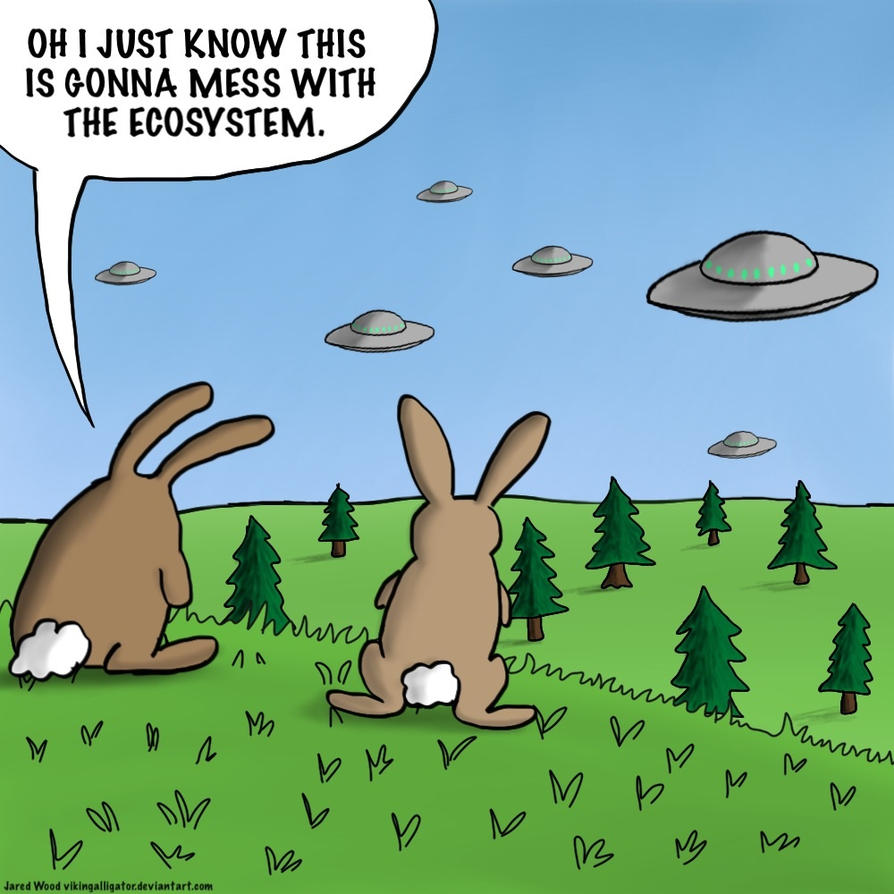
An invasive species is a living organism that is not native to an ecosystem. Many invasive species get to an ecosystem they don't belong to through humans traveling/trading. Humans have introduced many species to ecosystems they don't belong to. An invasive species is usually harmful to the environment since it can disrupt the food chain. If there was an additional predator added to an ecosystem, the prey might be eaten faster killing both predators or the invasive predator might eat the prey faster than the original predator, leaving the original predator with nothing to eat.
SP6 - Constructing Explanations and Designing Solutions:
This week, I constructed explanation about the invasive species I was studying which was the Asiatic Citrus Canker and I designed solutions by suggesting ideas on how to stop the disease from spreading/getting worse. I constructed an explanation of the basic information of the Asiatic Citrus Canker (where it was originally from, what type of species it is, what it does, the impact, etc.). I also found out all actions that were/are taken to attempt to eradicate the disease. That helped me construct the solution to the problem that the Asiatic Citrus Canker was causing. I suggested that we should continue disposing of plants with the Citrus Canker to stop and prevent its spread. Also, farming tools/equipment should be sanitized to prevent the disease from infecting the plant.
XCC - Stability and Change:
The system that by default stays the same/stable is an ecosystem. The primary consumers eat the producers (plants), the secondary consumers eat the primary consumers, and the tertiary consumers eat the secondary consumers. An ecosystem usually remains stable since there are always producers growing and providing food for the primary consumers. However, if there is a new species introduced into the ecosystem, then the ecosystem will most likely collapse/become unstable. The invasive species could speed up the amount of prey (specifically primary consumers & producers) being eaten which kills off the animals that eat that prey and eventually kills/significantly decreases the top of the energy pyramid. The invasive species could also introduce a new virus/disease that its native ecosystem is immune to, but not the non-native ecosystem it is in.
Subscribe to:
Posts (Atom)