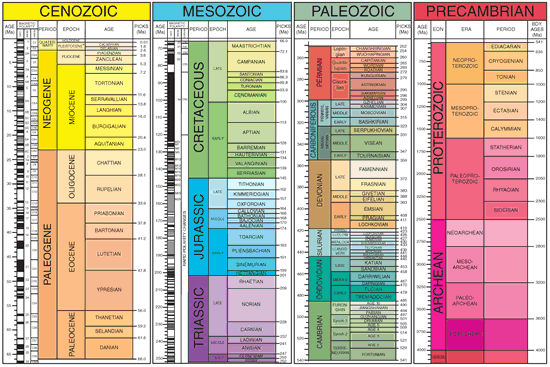
The Paleozoic Era was the era of evolution which lasted from 544 million years ago to 245 million years ago. Following the Pre-Cambrian Eon, the Paleozoic period started the biggest biological change for all organisms on earth and for many millions of years to follow. The Paleozoic Era saw the formation of the supercontinent Gondwana. The supercontinent had South America and Africa with Antarctica, Australia, India at the bottom right of the South America-Africa combination. This supercontinent was located at the southern hemisphere of earth. In addition to Gondwana, there was also the supercontinent Laurasia which was North America with Eurasia at the northern hemisphere. By the end of the era, Gondwana and Laurasia began to separate and form the continents in the Mesozoic era.
As I have stated previously, the Paleozoic Era had the biggest biological change. The Carboniferous period produced a lot of carbon which in turn, made many plants. Progymnosperms look very similar to gymnosperms and conifers, except that the progymnosperms create spores to reproduce. There were also glossopteris which lived from 300 MYA to 200 MYA. These were plants that contained wood and had tongue shaped leaves. Cycads are plants with a crown of large leaves with a thick trunk and fairly resemble small palm trees. They are very scarce and are not as common than they were in the Paleozoic-Mesozoic era.
Along with plants, there were animals. However, they were aquatic because the Paleozoic Era was a major biological change mostly for aquatic organisms and was only the beginning for evolution for them. The most common one was the trilobite which was the most earliest anthropod you could find in earth's history and looked like a very fat centipede. It first appeared during the early Paleozoic and went extinct during the mid Paleozoic era. There was also the blastoid echinoderms which resembled starfish and like the starfish, lived underwater. They went extinct during the late Paleozoic era (Permian Period) due to the Triassic extinction which saw the largest mass extinction in the world. Branchiopods were the earliest versions of plankton and as such were like plankton. However, along with the blastoid echinoderms, they went extinct during the Triassic extinction.
During the Paleozoic Era, the climate was rather warm. Throughout the early to late Paleozoic Era, it was warm due to the fact that many glaciers had melted from the late Pre-Cambrian era. However, there was a small bump in climate during the Devonian period which may have occurred due to the fast evaporation rates, but went back down as the Carboniferous period took over. The last period, the Permian, saw a massive spike in temperature. This happened because of the formation of Pangea. When landmasses stuck together, it created mountains, but gave opportunity for volcanoes to form as well, which may have led to the Triassic extinction. The noticeable geological changes were first seen during the Ordovician period during the formation of Gondwana and Laurasia which created the Paleo-Tethys, Pathalassic and Iapetus Ocean. During the late Ordovician period, rapid sea-floor spreading occurred which created the Rheic Ocean between Laurasia and Gondwana. The Permian period saw the beginning of the formation of Pangea which meant that landmasses came together to form mountains and volcanoes.
The Paleozoic Era was the era that began life. It was warm which made it suitable for basic life. The formation of Gondwana and Laurasia helped that happen. During the Paleozoic Era, plants such as progymnosperms, glossopteris and cycads along with the many marine animals such as trilobytes, blastoid echinoderms and branchipods had the chance to evolve and some even became some of the animals we know today. The era saw the beginning of Pangea, which meant that landmasses came together. This formed mountains and began forming volcanoes. Although the era ended with mass extinction, it made way for the Mesozoic Era, where the spotlight shined on the dinosaurs.
Monday, September 18, 2017

Sunday, September 17, 2017
The Geological Time Scale - (9/11 - 9/17)
 |
| Image Source: https://goo.gl/G6icTZ |
Summary:
The Geological Time Scale is a calendar for all the major events that happened on earth. The time scale has eons, which are the biggest unit of time. Eons are incredibly long- so far there are only two in the Earth's life of 4.5 billion years. The first eon is the Pre-Cambrian eon, which was the eon before life on earth and was the setup for the Phanerozoic Eon, which is the eon in which life begun. We are still currently in the Phanerozoic Eon. Eons on the geological time scale are then split into eras. The Pre-Cambrian Eon is split into the Hadean, Archean and Proterozoic Era. The Phanerozoic Eon is split into the Paleozoic, Mesozoic and Cenozoic eras. The Paleozoic era was the beginning of life on earth, especially for aquatic life. The Mesozoic era was the era of the dinosaurs, and the Cenozoic era saw the rise in mammals being the dominant species.
SP6 - Constructing Explanations:
This week I constructed explanations through the work of my research of the Geological Time Scale. Currently, I am studying the Paleozoic Era. So far, I have found out that the Paleozoic Era was the beginning of life on earth and was a step forward in evolution, especially for aquatic life and plants. Arthropods who are the ancestors of spiders and Trilobites are some prime examples. The super-continent of Gondwana also formed during that era. As I found more and more information about the Paleozoic Era, I constructed explanations about the major events in that era through my notes and shared a bit of information with my team.
Thursday, September 7, 2017
History of Rocks (9/5 - 9/10)
 |
| https://goo.gl/VHHwCo |
Summary:
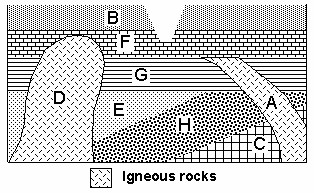
Rocks are everywhere on earth. They may seem inexpensive and invaluable since there is a lot of them, but some rocks can tell a lot about the earth. Fossils are rocks that preserve the remains of deceased organisms. There are resin fossils which preserve insects through the sap of a tree, trace fossils which document activity from deceased organisms from bite marks, footprints, etc, and body fossils that preserve the bones of dinosaurs when they were near a body of water. It is impossible to find the absolute age of the rocks, or the number of years since it formed, since the rock doesn't specify such information. Instead, you have to find its relative age based on the location and circumstances of where you found the fossil. The deeper the rock is, the older it is, unless it is a fault or a cut through the layers of rock.
SP2 - Using models:
This week I used models to help illustrate what the rock cycle looks like. The first step was to get four starbursts, and cut them into strips, then into bits. Scramble the bits and then evenly divide them into four. Next, grab one fourth of the starburst bits and crush them into your hands, molding them together to simulate how sedimentary rocks form. Then, apply heat and pressure onto the molded bits by putting the fused bits into a Ziploc bag and pressing down on it with a text book. This will simulate the formation of metamorphic rocks. The final step is to microwave the metamorphic rock for two minutes and observe the changes. This will simulate the formation of magma when the metamorphic rock melts and then the formation of igneous rocks when the melted starbursts cool down and harden. This activity helped me when finding out the age of rocks since it helped me visualize how igneous rocks are usually younger than the rocks beneath it.
Thursday, August 31, 2017
The Rock Cycle (8/28 - 9/3)
 |
| Image Source: https://goo.gl/qf3FgR |
Summary:
The rock cycle is an indefinite cycle which changes the type of rock constantly. The rock cycle starts off as magma but when it is cooled down, it turns into igneous rock. When the igneous rock is exposed to weather, it is turned into soil. Through erosion and deposition, the soil is turned into sediments. From here, the sediments are lithified, or compacted and turned into sedimentary rock, which are somewhat like fossils but with sediments. After a sedimentary rock is formed, it can be melted back into magma, exposed to weather and turn back into soil, or continue on by being exposed to increased temperature and pressure from folding and faulting. If it does increase temperature and pressure, it is turned into metamorphic rock, where it can either be melted into magma or reduced to soil through exposure to weather.
SP4 - Analyzing Data:
This week I analyzed data of the rock cycle by creating a drawing of the rock cycle from the results of a rock cycle simulation. In the drawing, there was all the steps of the rock cycle in a circle. I then connected each step of the cycle together then explained how a rock got to that step of the cycle. For example, magma, when cooled down, turns into intrusive/extrusive igneous rock depending on where the magma cooled. With that information, I made an arrow between magma and the extrusive and intrusive parts of the cycle and explained how magma became either of those rocks. Due to weathering and exposure, the igneous rocks turned into soil, and from erosion, the soil turned into sediments. The sediments turned into sedimentary rock through compacting, and from the increased temperature and pressure, the sedimentary rock turned into metamorphic rocks. When the metamorphic rocks melted, it turned back into lava. These steps are only the full rock cycle. During the cycle, certain rocks can go back or skip a few stages. For instance, most rocks can go back to soil when exposed to weather and sedimentary can skip the metamorphic stage by immediately melting to lava.
Sunday, May 21, 2017
Urban Environmental Accords - (5/15 - 5/19)
 |
| Image Source: https://goo.gl/SnUMHb |
Summary:
The urban environmental accords are a set of twenty-one rules that aim to protect the environment, public space, and the health of an urban civilization. The first set of accords lists a set of rules that are intended to reduce energy consumption and introduce renewable energy as an energy source. By reducing the amount of energy being used and having a bit of renewable energy, this reduces air pollution. The next set of rules requires that there must be zero waste in landfills and no harmful substances/products, which reduces the amount of methane going into the atmosphere, decreasing the rate of global warming and making the air quality better. The third, fourth and sixth set of rules ensures that all residents of/and an urban space are healthy. The fifth set reduces the amount of individual vehicles being used, thus reducing the amount of emissions being sent into the air. The final set of rules guarantees accessible water for everyone in the urban space. All these rules ensure that the environment is preserved and the people are healthy and productive.
SP8 - Communicating Information:
This week I communicated information through the form of a ThingLink, which is an interactive image. The subject that I publicly communicated is how my urban village complies with three environmental accords. I persuasively showed how my urban village complied with the three urban village accords by referencing the furnishings report often and then explaining how the furniture is environmentally friendly (furniture such as solar panels, drinking fountains, etc.). Along with the explanation, I added a brief description of what the accord was, to make sure that people knew what I was talking about. The final thing (unimportant yet relevant) I added was an image to support the rule and my claim.
XCC - Stability and Change:
The subject that relates to stability and change this week is the environment. The environment has been changing constantly but has changed more frequently since the industrial revolution due to the fact that many sources of energy had emerged and polluted the air and the increase of demand of resources has caused forests to disappear. So the environment is constantly changing due to human activity. It is impossible to make it completely stable, because there will always be a need to resources and buildings to pollute the air. However, it is possible to make the constant changing of the environment close to stable by recycling resources. That would mean that there would be a less demand of resources, which means that sources of resources could remain. Renewable energy is also a way of helping the environment, as it reduces pollution in general.Sunday, May 14, 2017
The Environment - (5/8 - 5/12)
 |
| Image Source: https://goo.gl/05UH5V |
Summary:
The environment is home to billions upon billions of species on earth. There are many parts of the environment. The atmosphere is the layer of gases that protect earth from harmful things such as radiation. The biosphere is the region that is occupied by organisms (land, ocean, sky, etc.). Finally, the hydrosphere are the sources of water on earth. These parts of the environment are rendered useful to us since the hydrosphere is necessary for life, the biosphere provides home for all living organisms, and the atmosphere provides oxygen, protects earth from harmful rays from the sun, and traps heat which makes the earth a good place for life.
Constructing Explanations:
This week, I constructed explanations through the 21 Environmental Accords sheet. the 21 Environmental Accords is a list of agreements of actions that cities that follow these accords must take in order to maintain a healthy environment. In summary, the 21 accords say, "Reduce the use of energy, reduce waste, ensure cities are safe and environmentally friendly, protect the environment (especially in urban areas), ensure public transportation that is accessible within walking distance in the city that does not affect the environment, and ensure everyone is healthy and has access to safe drinking water. In this sheet, I worked with the person sitting next to me to construct explanations essentially translating the 21 Environmental Accords into our own words. After that, we asked, "what is the purpose of this environmental accord existing?" and wrote down the purpose(s) of why that environmental accord existed and its (positive) impact on the environment.
XCC - Cause and Effect:
One cause and effect relationship I noticed this week was regarding the environment and the sources of pollution. Since there are more emissions being put into the air and there are more forests being deforested, the global climate is increasing at a rather fast rate. Another effect that comes from pollution is that the biosphere is being affected. Since there is also waste being put out in the ocean, it is harming, if not killing the sea creatures that inhabit the source of water which not only can affect the food chain, but is also harming the hydrosphere which is our only source of water, which can eventually kill us. These are the cause and effect relationships I noticed that come from pollution and effect the environment
Sunday, May 7, 2017
Steady heartbeats may depend on white blood cells (5/1 - 5/5) Article Blog
Article Source: Eaton, Elizabeth. "Steady Heartbeats May Depend on White Blood Cells." Science News for Students. ScienceNewsforStudents, 05 May 2017. Web. 07 May 2017. <https://www.sciencenewsforstudents.org/article/steady-heartbeats-may-depend-white-blood-cells>.
Summary:
According to a recent study made by Matthias Nahrendorf and his cell biologist team in Harvard Medical School, macrophages (immune cells) may most likely be linked to the constant beat of the heart. The macrophages lie between heart muscle cells and helps the heart muscle cells receive electrical signals in order to pump the heart in a consistent pattern. Researchers have known about macrophages in the heart but didn't really know much else. Nahrendorf found that a mouse that had very little macrophages in its heart didn't have a consistent beat through the MRI scan, which lead him to discover macrophages are linked to the heart.
SP8 - Communicating Information:
In the article, the author communicated information by sharing the study made by Nahrendorf. What the author did was include what the discovery was, who did it, and how the study was made. By making this article, the author has shared new information that no one has known before. This is taking a step forward in the understandings of nature since it gives us more information about how the heart works. Researchers/Scientists can use this information to their advantage and perhaps treat heart diseases related to the rhythm of the beat of the heart.
Subscribe to:
Posts (Atom)